There are two chances to win, and the more people you recommend to the giveaway, the more entries you get. Not only does your chances of winning go up, but if your friend wins, they can only read 1 book at a time so you can borrow the others. It’s a win-win for everyone. You’ll also get the free copy of my prequel to Pool of Echoes, Dive, as well. Enjoy!

Sign up on the right hand side to get the book.

Pool of Echoes – Audiobook
The Pool of Echoes audiobook is finally out! You can find it on Audible and at other retailers reached through FindawayVoices.
This was a fun audiobook to narrate, and while this isn’t my first voiceover gig, it was my first audiobook. Hope you all love it.
The music track was a song I produced as well called Descent into the Deep.
I’ll surely narrate more audiobooks in the future… maybe Emotionally Bulletproof… maybe some other things you haven’t seen before.
Get Pool of Echoes the audiobook here on Audible or wherever else is comfortable for you.
Thanks again for everyone who helped Pool get made and the readers who have given me such great feedback on the book.

 ‘No’ sucks.
In my life, I’ve heard that word way more often than Yes.
The word No is, for me, like stairs are for the Kung Fu Panda: Unpleasant, and there are way too many of them.
Example: During one of my nine sales attempts (each lasting for 2-6 months), I sold credit card processing services. During that 6-month time, I’ve heard the word No over 7000 times, and heard the word Yes… MAYBE five times? This was my second most successful attempt at a sales-type job.
As you can see, the law of numbers has not historically worked out in my favor.
If you’re reading this and thinking: “This is me right now!”, you’ve probably come to one of several conclusions:
First, you must improve your skills at getting to yes.
Second, you must find a way to make NO hurt less than it does now.
There are many ways to do the first one, most of which is education and training. Learning about trust has helped me with some of that, which is why I wrote the Emotionally Bulletproof books. Trust has allowed me to hear more No’s than I could have faced otherwise, and has helped lead to Yes in a few profound ways throughout my life.
For the second part, you must perform some level of mental fortification. You’ve got to build some walls.
The best walls are like the walls of your cells, the tiny wardens protecting your body. They have permeable membranes, so they will let some stuff in while keeping other stuff out.
So how can you develop a wall – a permeable membrane – to keep the No’s from hurting?
Watch these logical gymnastics. They may work for you.
DISCLAIMER: These scenarios are related to business No’s, selling to strangers, where the line between respecting people’s boundaries and being a jerk is thicker and harder to define than romantic relationships. Do not test the boundaries of a romantic relationship using this type of logic. Life experience has taught me that many of these are No’s in that area of life.
But when your livelihood is on the line and you’ve got to make that sale, read on.
Is This ‘No’ Qualified to Hurt You?
I’ve found that most aren’t. So I’m listing some No’s that you should no longer even count as No’s. They are pretenders, and trying to take good paying jobs away from the hard working No’s that belong in this country!
Sorry, wrong rant.
Here are the ones that don’t count anymore:
If the person in front of you does not have the authority to say ‘Yes’, it isn’t technically a No.
If the decision maker was angry, stressed, or tired right before you showed up, it’s not a No.
Can you possibly put them in a better mood? Yes. Skill plays a factor.
Sometimes you can even judge timing to reduce the likelihood of this, and it’s your responsibility to look into that. Sometimes, however, there’s nothing you can do. They wanted to say No to something and you showed up right on time. They probably weren’t even really listening.
If they didn’t understand what you were offering, it’s not a No.
Given, you have to take responsibility for how clearly you communicate; that doesn’t ever change. Still, some people are easily distracted, dumb, late to come to the meeting and early to leave, illiterate, etc. Also, if they say Yes to things they don’t understand, they aren’t your ideal customer anyway.
If you left a voicemail, got lost in a phone tree, or had to leave an email… if you didn’t get a response it’s not a No.
Most people are busy. Some people (Me) are cowards, and don’t want to say No to your face. Make sure the No doesn’t count unless you hear it from them.
If they said Yes to someone else offering the same thing, it’s not a No; it’s a Not Now.
I don’t care if their brother does their photography for them. Maybe their brother will move/quit/get sick/go on vacation/die tomorrow. If they said Yes to somebody, they have a need. It’s just not you that’s fulfilling that need right now.
If they said Yes in the past to someone who burned them, and now they don’t trust others, it’s not a No.
You just need to build trust with them. Decide whether or not it’s worth the time and choose. Bad apples ruin it for everybody, most of all for those who can’t hear No.
If they give an objection, it’s NOT a No.
Objections usually mean they want to talk to you about something. This can be good. If they have many objections and still manage to find a few more, it IS a No.
If they do not have the money to say Yes, it is a No.
If they haven’t graduated middle school, have no job, or are bankrupt, they usually aren’t your ideal customer.
If the decision maker is unavailable due to busy season, family emergency, vacation, etc, it’s not a No.
If they’re going out of business, it’s not a No.
Humor aside, there is a delicate balance between respecting boundaries and knowing when to keep asking questions. It’s a balance I’ve never fully learned, so don’t take me as the source of all wisdom here.
In any situation, it is your responsibility to learn and adjust to the circumstances of life. Respect people’s decisions, and try to know when they’ve truly made a choice one way or another.
BONUS: If the cops are escorting you off of the premises, guess what? You’ve just heard a No.

This post is about evangelism.
Here’s a question for you. If someone says:
I don’t believe in Jesus or God, but my life is awesome and yours isn’t so good, why should I be a Christian?
This question has bothered me for years.
For a long time I thought, when I’m rich/married/successful, THEN I’ll share God’s word because people will listen.
This, however, hasn’t stopped the disciples, who were mostly poor. On the other hand, rich people have often talked about God, from King Josiah to John Templeton to Ben Carson, and their voices are ignored at best or ridiculed at worst.
There are people who will ignore God no matter who the message comes from.
It’s not your job to save souls. It’s your job to make salvation available.
I’m almost 29 and not rich or married. I have had some success, but not enough to brag about. So, waiting until I’m ‘good enough’ would be a tragedy.
Personal development and goals aside, there is a chance I may be waiting for a day that will never come.
If you’re wondering the same thing about your life, and would like to answer the above question, here are 11 ways I’ve gone about it.
Feel free to steal, copy, share, etc. If you want to link back, I’d love it.
Imagine your boss is asked you this question; Your atheist boss drives a nice car, has 3% bodyfat, makes three times as much money as you, and the ladies love him. All responses are crafted for this hypothetical boss.
1. It’s God’s Job to Give You a Personal Experience. It’s Your Job to Ask.
The reason many people will remain Christian no matter what an atheist may show them is because of the personal relationship Christians have with God.
You believe in gravity because one day you fell and got hurt. You have a personal experience with gravity.
If it weren’t for science class, experts on TV – explaining orbits, velocity, mass, & magnetic pull – and stories from astronauts outside of earth’s obit, you would NEVER believe that you could jump in space and just float.
You can test this: in fact, the Bible tells you to test the spirits (1 John 4:1). It also says ask and you shall receive (Luke 11:9-10). You could ask, in private – so you don’t embarrass yourself – that if God is real, that He give you a personal experience. You will only look into it further if you get one. Then, just in case, you’ve given Him a shot.
2. Correlation Does Not Equal Causation.
While at this moment you may be doing well, and I may not be doing as well, consider this:
How many atheists and agnostics are doing terribly despite having the same belief as you? How many people are doing well who believe in God? You’ll find large numbers in every camp.
Not all who believe in God are failures, and not all who are atheists are successful.
I’ve found that success is often a combination of choices, mindset, work-ethic, awareness, consistence, and good-fortune. Keeping it usually requires at least 2 or more of those things.
3. Success on Earth Never Includes a Promise of Eternal Life
Jesus lacked for nothing until his crucifixion, even though he often took nothing with Him when traveling.
The patriarchs, prophets, and apostles of the Bible came from widely varying financial situations.
Abraham, Job, Joseph and Matthew were all rich at some point.
Peter was a poor fisherman and John the Baptist lived in the desert.
Paul was middle-class, and rocked a pretty cool side-hustle during his travels.
All of them recognized that a relationship with God was the source of eternal life and that this had a high value – more than anything that could be achieved here on earth.
4. Different Journeys Lead to Different Destinations
You and I are in different places today. Why?
The short answer: because that’s where we are.
We’re going towards different finish lines on the journey of life. All I’m saying is to go for the ultra-marathon rather than the 5k.
5. My Failures Aren’t God’s Fault.
Israel was the chosen nation of God for the entire Old Testament, yet they failed constantly. They failed so bad you’d think it was their job description.
Even Athiests must agree that my failures are not God’s fault. This is true whether He exists or not.
6. If You Credit Personal Success With Unbelief in God, Who or What is Rewarding You?
And just as important: Why?
My guess narrows it down to one of two things:
First: People – the same 2-legged homo sapiens who I interact with every day. If people are rewarding you for this, then the feedback loop for you is a matter of politics.
Politics tend to swing like a pendulum – watch the elections in any country. In my opinion this swinging will just get more and more violent, but I digress.
When leaders, friends, family, and the media decide it is politically popular to believe in God, will you find your faith then, or stick to your current belief system?
Second: Something you don’t believe in. A supernatural entity who is willing to expend resources to keep you from finding God. Some might call it ‘The Devil’. The Devil – over the long-term – would stand to lose more if you should so much as look at Christ.
7. If I Choose God and Don’t Get Rewarded, Whose Fault is it?
This is a reversal of #6, just in case you feel like I’m picking on you.
It goes both ways. If I choose God and do worse, it’s one of three things:
First: My choices and mindsets are the problem. Either God’s ways are right and I don’t adhere well enough to them, or they are wrong.
Second: Political. Religious people have a tendency to pick one side and stick with it (see Martyrs). If it’s popular to believe in God, that’s cool with them. If it’s not, they get punished by people in power during those times. These are often the same times when telling the truth to people who are hurting others, or whistle-blowing, can be a career-killer.
Third: Adversary, a.k.a. The Devil. Imagine we elected a president that truly tried to do the right thing by all Americans. S/He stopped the Fed, punished those responsible for the bailout, indicted the cops that brutally killed unarmed people, lowered taxes, vetted all immigrants, made it way easier to travel, put in term limits for congress and the senate, lowered the deficit, etc. ALL those things. If s/he couldn’t be blackmailed or killed, the systems controlling those elements could cause all the markets to collapse in the middle of that president’s term, so that the ‘Good’ president would take the blame for the whole house of cards falling down. They would take the blame even if the problems had been started and exacerbated over a hundred years.
Where am I going with this? If I choose God, I may get hit so it will look like the evil is all God’s fault when it really isn’t.
It’s the system, man!
8. What are You Giving Up?
Jesus wanted the rich young ruler to recognize that a relationship with God was more valuable than everything else (Matthew 19:16-22).
However, choosing God doesn’t always mean quitting your job, selling your car, and dating women you don’t like. God just wants you to have more respect for the Creator than the creations. Then, you appreciate what you have even more. Your fear of loss is cut way down, so much that one day you might even say: O Death, where is thy sting?
How cool is that?
9. Pascal’s Wager.
If you believe in God and are wrong, you lose little. If you don’t believe in God and are wrong, you miss out on a LOT. Enough said.
10. God Wants Relationship; He Doesn’t Want to Treat You Like a Dog
Pavlov’s dog is a psychology term associated with behavioral conditioning. A dog was fed after the ringing of a bell so many times that the dog would hear the bell and start salivating even when no food was there for it to eat.
Humans are not the new dog.
If all Christians got rewarded while all non-Christians got screwed over by life, 99% of people would call themselves Christian. Very few would be doing it because they had real love for God. [See Job Ch 1]. God wants us to independently choose Him out of free will.
11. How Christian Are You, Really, Without Even Knowing It?
Christianity is famous for forgiveness, yet it is more conditional than most people think it is.
Christianity means following Christ. Doing what God says.
So, if someone treats others horribly, doesn’t love, and says they are Christian, are they?
No.
If someone isn’t perfect but they own up to their mistakes and love people, is that person more Christian or less? More, even if that person had never heard of Jesus.
Many Christians who are doing badly are reaping the consequences of not being very Christian, and many atheists see it and blame God for their actions. At the same time, some atheists grasp the fundamentals of true Christianity and are rewarded for it.
Again, what are you giving up, if that’s the case?
Thanks for reading. You are more than welcome to share this with others who are struggling with this question in their lives.
Caution: Spoilers inside. If you’re going to see the movie, watch it then come back to this.
If you’re still thinking about it and are just as intrigued by HOW something happens as with WHAT happens, read on, friend!
Movie poster taken from TheHollywoodNews.com
There is wisdom in childhood.
Think back to when you were a kid. There were things you wanted to do, or a certain way of doing things that just seemed natural.
Then you turn 12 or 13. You go into middle school, and if your passions aren’t respected or valued by your peers, you start building a filter. Band is for nerds. Nerds don’t get girlfriends. I want a girlfriend, but cannot get one if I am in band, so I’ll stop playing the saxophone, even if I love it.
This gets amplified in high school. Hopefully you go to an out-of-state college where you get a do-over – where people are so busy trying to build their futures and are so open-minded that you can explore these things without judgement.
Joy didn’t get that do-over, but she remembered who she was after years of living through what she wasn’t. Those memories from childhood reminded her of what she was willing to work so hard on, so she would never accept failure.
I heard a quote somewhere: If you think adventure is dangerous, try routine – it’s lethal.
Your problems are not just your problems.
Think of what other people need and if you solve that need, you can become wealthy. All the gurus say that because they are right, but there was always a disconnect when I read that.
People. Who are these people? What the hell do they want? The concept of other people is so abstract. Are we talking about Americans, my family, the people in my town, “the rich”, coworkers – which people?!
Joy was trying to mop up broken glass and cut her hand. Joy realized that SHE WAS people. She had problems, dammit. So she set out to solve one of her problems, thinking that if she had that problem, other people did too.
That’s the connection.
What do you need? It’s a question that you often answer when you are pissed off.
Thinking about yourself isn’t always selfish. Expecting other people to solve all your problems for you is.
That being said, Joy spent most of her day solving other people’s problems. Almost to a fault. There is something called boundaries, where if people act like you’re their servant, you call them out on it, but only to the extent that they start taking care of the things you know they can do.
Joy didn’t do this, and she suffered for it. But she also got the social equity needed to guilt trip her dad into pitching his new girlfriend on her idea. In most people’s eyes that is justified.
In this lack of boundaries, she managed to cultivate a determination to move forward no matter what. That determination could have been bred outside of such a toxic environment, but in this case it was because of the toxic environment.
Two trustworthy friends can be better than your entire family put together.
Sometimes your family is going to misunderstand you. They aren’t trying to shelf your talent, they are just so busy trying to mold you in their image that they forget you are your own person.
That being said, in this movie, Joy’s family is terrible. They are lazy, co-dependent, and turn on her like jackals whenever she’s wounded. It’s enough to sink most people. We are the average of those we spend the most time with, which is why becoming rich from nothing can be a big challenge.
My Mom was like that. I loved her in spite of it, but she died, so she didn’t have the pulse to shame me for wanting to write. I couldn’t imagine having four or more people like that all the time.
In contrast, Joy’s childhood friend truly got her. She saw the light in Joy’s eyes when she did what she was born to do, and knew what it was to face adversity. Joy’s fight was her fight as well.
Joy’s ex-husband was kind of a fool in this movie, but he couldn’t be anything but who he wanted to be. He didn’t get a lot of respect, but his gut feelings about manufacturing partners were spot on – as you’ll see. He knew what a conflict of interest was. In fact, he avoided conflicts of interest so much that he was unemployable in the adult world. Joy tolerated him because – subconsciously – that’s all she wanted for herself, too: to live her own life doing what she was born to do, even though it would have been irresponsible to live like he did. Her husband’s transient job history gave her the connections she needed to meet the people running QVC.
Success brings its own challenges
When you finally start succeeding, some people see you as a target. Joy’s manufacturer raised the price high enough to kill the product, and tried to knock off her design because they couldn’t figure out how to make the idea work for themselves. Notice that this happened AFTER her product started selling.
She gets angry, and the police come in. People who enforce laws will misunderstand you, especially if you create. Enforcers exist to maintain systems, and creation is by nature disruption.
And when our creative babies are stolen from us, we blow up. We lose our shit! Those who were born to enforce laws have tremendous value to our security, but most won’t empathize, and can’t help with that even if they did.
Getting successful is one thing, staying successful means continuing to do what got you there. Learning, growing, fighting, being misunderstood, and it’s lonely at the top without those friends to back you.
Business friends are not always the same as true friends.
They will spend time with you when it is in their financial interest to do so. If you’re lucky, you will have respect for each other even when it is not. They’ll give you a shot if what you’re saying makes sense, but only if it makes sense. So make sense.
Passion is everything
QVC hired the best salesman they had to sell Joy’s product and he made a mess of it. I believe that was meant to be, because Joy was meant to be on that stage, selling her ideas to the world. If the actor had succeeded, it would have been a tragedy against mankind. Joy would be free from her problems, but not from her insecurities.
Joy knew the problem she was solving. Joy knew the product, and she knew that if anybody else did this for her, nobody would understand how their lives would be improved.
Joy was the low-tech Steve Jobs. Steve had passion, which is what made him so good at showing people what they wanted in such a way that they absolutely needed it.
In her first interaction with the salesman, Joy knew this lesson; it was just hidden in her gut. Director David O. Russell and the actors did such a good job making you feel that same tug under your ribcage as you watched the scene.
Is it all worth it?
Someday…In a few decades, years or even months – we’re all going to die. This is going to happen whether we invent a mop that changes an industry or not. Even if you don’t make a single dime your entire life, you’re not exempt. Religion gives you pretty good answers to what happens after, but until we live it, we don’t really know.
Joy went through a lot of birth pains before she could be rewarded for her talents, and continued to experience failure. The narration says her own family tried to sue her, even after she funded their ideas. Was it all worth it?
If you expect other people to solve your problems, the answer is no.
But if you want to solve other people’s problems, including your own… then maybe.
Sooner or later you realize everything from the last few paragraphs and decide. You would rather die living, than live dying.
When Joy goes to Texas and has her own private chat with the invisible enemy who had sabotaged her through half the movie, she had hit that point. From there, every ounce of pain was worth it, and when he saw that in her eyes, it was over.
Watch this thing
This movies comes out Christmas 2015, and I was fortunate enough to see it in advance through sheer luck. Watch it. Some of Robert De Niro’s lines are a little too on the nose, but aside from that it’s a fantastic movie.
 You probably remember the first time you prayed and something happened, even if it was really small.
Maybe, like one of my childhood friends, you prayed for pizza at dinnertime, and ta-da! There it is.
One friend of mine has a daughter who prayed that the automatic window on their SUV would work again, after weeks of malfunctioning. Ta-da, now she can order milkshakes at Sonic.
And it’s hard not to roll your eyes at the myriad parking spot miracles out there. It’s enough to fill a very boring book.
And on the eighth day, Adam sought a space large enough for his Prius. The sun approached its apex, and the cinnamon rolls he desired would soon be discarded, forever out of reach. So he closed his eyes to pray and – lo, and behold! – his front bumper knocked over a parked motorcycle, giving him enough clearance to set up camp.
This gave me a really skewed idea of God. Shouldn’t you be praying to find a good spouse, raise good children, freedom of religion, and a fulfilling and prosperous career? How does finding a front row parking space outside of Whole Foods on a Sunday afternoon factor into God’s priorities?
How May I Help You?
Not wanting to skew HIS priorities, I decided early on to ‘help’ God.
No more praying for small stuff. God is an important figure in the universe.
Like, if a boss I wanted to impress gave me a job to do and I couldn’t find a pen, I wouldn’t bother him about it. Instead, I’d do what I have to, go buy a pen, and get the job done. Because, as I believed it, God shouldn’t be bothered with trivial things.
It would be better, I thought, to pray that I write a really great book, or built a business that gave me complete financial freedom. Or, if my spouse had a major disease one day, I’d save up my goodwill with God for a real big miracle at that moment.
If we’re dealing with regular human beings, that is a great idea. Except we’re not.
How Great is Your God?
I was trying to build what’s called Emotional Equity.
As if every time I didn’t bother him about something small, I preserved my capital with the Most High.
And every time I pursued my calling, or helped someone, He’d really pay attention when I prayed for the big stuff.
I was praying as if every prayer was subject to a holy audit.
You Cannot Bankrupt God.
Emotional equity is a great tool and a savvy way to live when building long-lasting relationships with people. It sucks as a foundation for your friendship with God.
 Tweet This
What God is really looking for is a relationship with you. Any prayer, of any size, opens the communication channels, giving you face-time with the Creator. Small ones build your faith. Big ones honor God’s capacity to bless you, and when fulfilled, they vindicate your faith.
In God’s eyes, every time you talk with Him, it’s a deposit!
So pray for the small, petty, inconsequential stuff. It’s cool, He want’s to hear from you. You’ll also be less nervous about prayer when you go to Him for the big stuff, and won’t hesitate to seek His counsel first – in all things.
 I was wrong. The kid praying for pizza was right. God is good.
Go for it. What are you going to do, wipe Him out?
Luke 18 (NIV) Then Jesus told his disciples a parable to show them that they should always pray and not give up. 2 He said: “In a certain town there was a judge who neither feared God nor cared what people thought. 3 And there was a widow in that town who kept coming to him with the plea, ‘Grant me justice against my adversary.’
4 “For some time he refused. But finally he said to himself, ‘Even though I don’t fear God or care what people think, 5 yet because this widow keeps bothering me, I will see that she gets justice, so that she won’t eventually come and attack me!’”
6 And the Lord said, “Listen to what the unjust judge says. 7 And will not God bring about justice for his chosen ones, who cry out to him day and night? Will he keep putting them off? 8 I tell you, he will see that they get justice, and quickly. However, when the Son of Man comes, will he find faith on the earth?”
Photo Credit:
Reserved 12 by Steve Snodgrass (courtesy of Flickr.com)
Piggy Bank and Calculator by Images Money (courtesy of Flickr.com)

 Sometimes the crazy people you meet make so much sense that you realize you were the crazy one all along.
While researching for a book series, I became interested in all the things that make spies and MacGuyver-type characters so awesome. It’s the skills and problem solving, executed with a flare that is sock-rocking impressive.
On the way out from Lowes, getting supplies for a related hobby, I ended up chatting with a retired veteran.
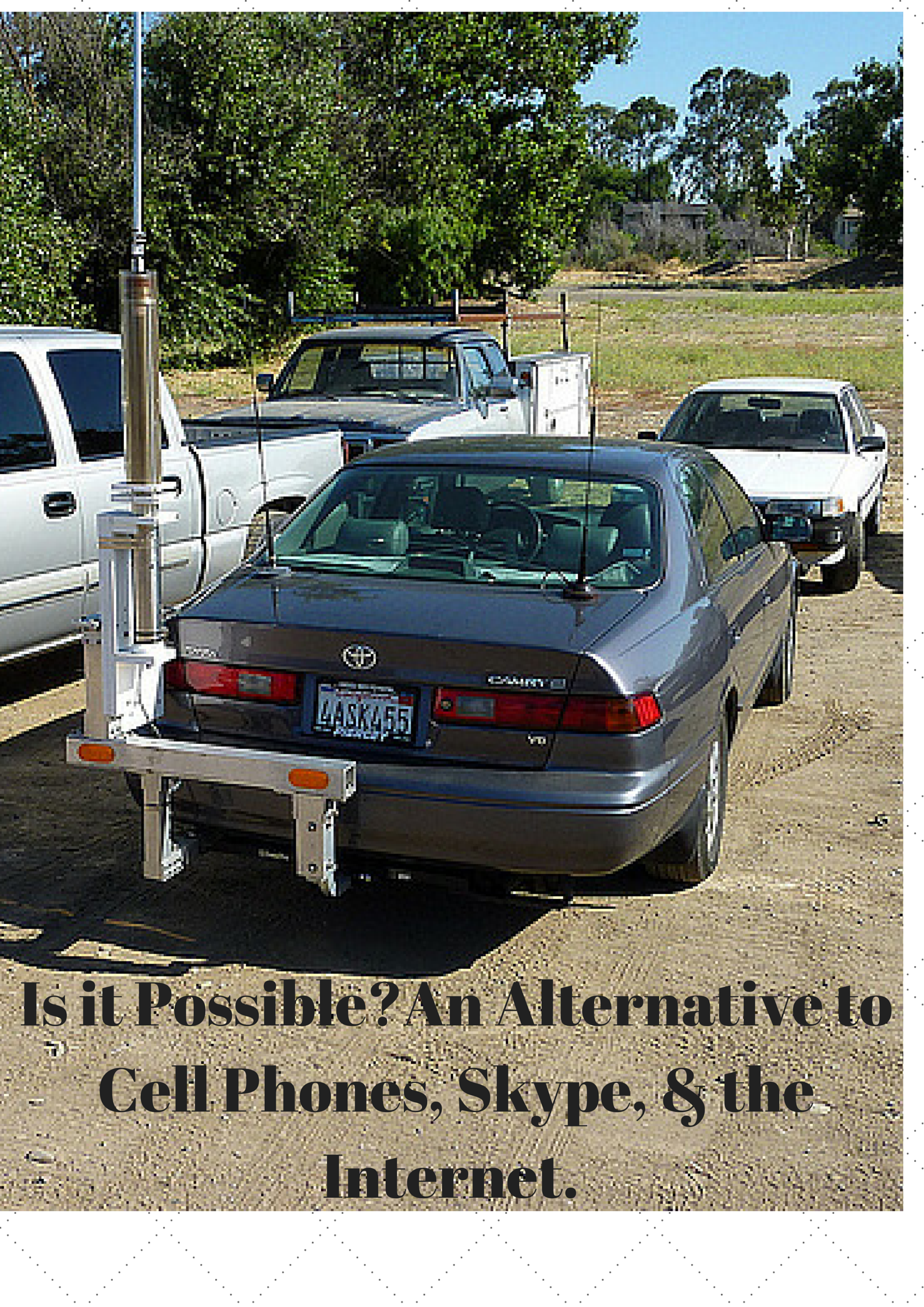
His car was a few spots from mine, and when I spotted it, I saw a monstrosity sticking out the back of his trunk. It looked like the photo to the left.
He also had two more antennas than the car in this photo.
“Anyone who pays money every month for a cellphone is a sucker,” he said.
“It’s not ideal,” I said, “But what’s the alternative? Do we give up text and internet, and tell all our friends to buy CB radios? ‘Breaker breaker one-nine, this is rubber ducky…'”
And he proceeded to tell me about HAM radio.
HAM RADIOS
I got the idea he knew something I didn’t.
He holds up what looks like a tan, military-style blackberry. “I can talk, text, and video chat with anyone I want, and it’s free.”
It sounds cool, but you probably have to have your own cell towers, and the equipment probably costs tens of thousands, I thought.
And then he tells me the large 80-meter transmitter on his car cost him about $680 bucks to build and install.
He can call on his handheld HAM to an antenna, which bounces it to the 80-meter (that tall tower you see in the photo), transmitting it pretty much anywhere in the world he wants.
I was skeptical, but then I gave him my number and he called it!
This meant he could talk to anyone using his HAM. Rock on. He could order a ham pizza using his HAM if he wanted to!
So not only could he call anyone, and do so away from his car, he could also do it for less money than most people pay for a year of cell-phone service.
Except, instead of paying a cell-phone provider to use their systems, he can drive around with his own radio tower.
Radio Tower? You mean like radio stations and stuff?
Yeah. AM, FM, CB, and a host of other frequencies. If you’re willing to look a bit like a nutcase, you can have a free radio that you can use to talk to anybody.
And Internet, too?
That may be the wave of the future.
There are organizations like the San Francisco hackerspace, Noisebridge, that are building an alternative network modeled after the Internet. This could provide high-speed connectivity for a fraction of the cost of traditional internet service.
Skype-style communications like video chat are already available to HAM operators. If your computer has a camera and it’s on, HAM operators can face-to-face with you.
And systems like Packet Radio allow you to make long-distance wireless networks to transfer text and other messages between computers. While a bit on the slower side, this technology could speed up as our need for it increases.
When it pays to be a nut
So why would we need it?
 I could think of a few reasons here with the FCC Net Neutrality rules…but instead I’ll let U.S. News do it.
Right or left, soccer-mom or hippie, I think we can all agree on this:
I don’t know about you, but oligopolies – industries ran by just a few companies – are something I’m against. Why? Because they can halt new technologies, treat customers badly, and even price fix if the existing anti-trust laws are not enforced.
In short, they don’t have your best interest in mind.
Same with bills our elected officials aren’t allowed to read. The U.S. News article has other reasons why it’s a bad move, but the fact that the Congressmen can’t read it is proof enough that it doesn’t have people’s best interests at heart.
That aside, let’s say regulation blocks certain parts of the internet, creating a digital gulag. Where’s the alternative? HAM can be that alternative – accessing necessary information during crucial times.
If superpowers like Russia can use ‘white boxes’ to block cell and internet signals, how are people going to communicate under such circumstances? What if extremists in the Middle East block signals while committing genocide against Christians and Atheists?
They can pray… if they’re willing to do so.
But what they can also do is use HAM to get the word out if they can’t use Twitter or Facebook.
But what about the most common reality we face in the western world today…natural disasters?
 The man continued showing me his tech as he explained, “A hurricane swept through a town in North Texas a while back. Me and a few friends – about ten of us – we went up to the town while all land lines and cell towers were down. For about a month, we provided communication to citizens and their families – for free. And there’s about 670,000 HAM operators in the US alone.”
The Great News
The FCC rules regulating HAM radios have created a special culture. I don’t know all the rules yet, but here are some:
1. HAM operators cannot use their equipment or HAM radio-related services to make money. (NOTE: I get the impression this rule is intentional, to protect the oligopolies while keeping the frequencies from getting too crowded)
2. They must be registered. (It takes more work to track down a HAM operator than the constant surveillance of cell users, but it is possible after enough signal watching)
3. No swearing. Keep in mind you are operating a radio, and a little kid could be listening to that frequency.
4. Morse code knowledge – just kidding, that rule was dropped in 2007. But still, the veterans of HAM radio can speak another language, giving them a whole new level of competence.
This means we have a bunch of competent people, who are generous and not predatory, with cleaner language than me.
My hat goes off to these 600,000+ people. All potential heroes, just waiting in the wings in case disaster strikes. The next time we see a Hurricane Katrina, A giant snowstorm in the Northeast, an EMP attack, earthquake, or civil unrest, know that you or a loved one could one day be assisted by one of many such heroes. These heroes can help call out and let others know they’re okay, get necessary supplies, and be a lifeline to their broken world.
Do You Want to Ham it up?
Learning about Ham-radios and their capabilities has filled a major blind spot in my quest to one day be self-sustaining. In the not-too-distant future I want to start accessing the conveniences of modern technology without sacrificing privacy, and this is a great way to do it.
And if you’d like to:
- reduce your dependence on oligopolies,
- save thousands of dollars
- look like a nut-job
- protect your privacy
- Anger your Homeowners’ Association
- Stop future-Hitler from getting away with murder
- and be a hero in the process…
Then maybe HAM radios are for you.
Find out more at many different websites, like the old-school HamUniverse, or check out the how-to guide from Wired.
Photo courtesy of Dave Parker on Flickr


Edge Conference by Jeffrey Zeldman at flickr
You ever spend time on an event for a specific reason, and then get something completely different out of it?
I came to the ReWrite conference last week expecting to get a lot of tips on how to improve on marketing, and perhaps figure out when a traditional publishing deal would be worth my while.
What happened instead is that I ran into my people.
You know, your people? A group you can be yourself around?
If I’m lucky I develop friendships with 1-2 of those kinds of people per year.
Imagine running into 100 of them in 2 days.
Esther Fedorkevich of the Fedd Agency set a strong, indie-friendly tone in spite of her traditional publishing background. The feud between indies and traditional publishers is fading fast, and she is definitely part of the solution in that area. Rest assured, I still hammered her employees with ‘Audit the Fed’ jokes.
Personally, as long as I live in a relatively free part of the world, I’ll use whichever route achieves the goals that matter to me, as long as those decisions are legal, moral, and ethical.
Traditional? Sure, why not?
Indie? Sure, why not?
Keynote speaker was Ted Dekker, who wrote the Circle series, Thr3e (also a movie), and many other bestselling novels.
People who stood on stage and said things
Like the subtitle? The tone of the festival was that all authors are equally important, because even the top selling folks were at one point learning the basics. And people learning the basics are just like the top sellers, traveling on the journey from where they are to where they want to be. It was a judgment-free zone, and even the major players were in the audience taking notes, just like everyone else. That is some real ‘walking the talk’.
At the risk of leaving out any names, or name-dropping, here were some other panelists and attendees:
- Mary DeMuth (@marydemuth)
- James Rubart (@jameslrubart – author and victim of kindle-spying by yours truly)
- SandiKrakowski (@sandikrakowski – social media kraken, and founder of the #BEMORE movement)
- Kevin Kaiser (@1ktruefans)
- Rusty Shelton (@rustyshelton of Shelton Interactive.)
- Claire Diaz-Ortiz (@Claire – yeah, one word. She’s a founding employee at twitter, and knows a lot about it.)
- Susan May Warren (@susanmaywarren and susanmaywarren.com)
- Chad Allen (@chadrallen at ChadRAllen.com)
- Ruth Soukup (@ruthsoukup of Livingwellspendingless.com)
- Rachelle Dekker (if that last name sounds familiar, it should – she’s releasing her first traditionally published book later this year)
- George Barna (@barnagroup of the Barna Group.)
- Mark Batterson (@markbatterson of The Prayer Circle)
Takeaways
Here are some lessons that anyone can take with them, writer or not:
“When you love your neighbor as yourself, you love yourself, because we are one.” – Ted Dekker
“Everything you do in life will flow out of who you are…rewrite what you believe about yourself.”
“Do not despise obscurity” – Mary DeMuth
On gurus and how following their checklists often fails to bring you the success you seek. “What if the ‘Guru’s’ advice works?! You might risk pointing to them or yourself rather than to God.” – Mary DeMuth
Just because God is in something, that doesn’t necessarily mean it will prosper the way we want it to.
“It’s difficult to read the label (your qualities) when you’re standing inside the bottle.” – James Rubart
“Culture is a gathering of people around a common idea, item, or belief.” [that is the goal of social media] – Sandi Krakowski
“Nobody [successful authors interviewed] could identify a single moment of breakthrough… they only noticed breakthrough after the fact.” – Esther Fedorkevich
All the moments pushing the flywheel led to the breakthrough.
“Think less like an author [on PR] and more like a journalist for a news outlet.” In the end, that’s what social media is, and our job as creatives or businesspeople or writers is to report on what’s making the most impact in our respective subject matters. – Randy Shelton
Don’t put your identity in your work. If you live by the sword, you die by the sword (paraphrase of Ted Dekker). On a personal note, I noticed you can replace ‘Sword’ with…well…anything. Also notice if you live by God, you die by God, but since He’s the source of salvation it is the only way that death turns into an illusion.
Chad Allen showed me something called the living systems theory, which in my opinion is one of the reasons that change can be so hard sometimes. Living Systems Theory = when you change 1 or 2 parts of a system, the whole system changes.
“If you spend your whole life teaching a fish how to climb a tree, the fish will spend away its whole life thinking it’s stupid” – Kevin Kaiser
So, should you go, if you’re a writer?
I’d say yes, if only to get your head in the right place. In the future, I’d like to see more case studies and tactical stuff, but it is what it is. If the above quotes helped your mind in any concrete way, look into it the next time the event comes around.

 Great news!
The rough draft of my next book is complete!
“That thing’s operational.” to quote Lando Calrissian.
Originally written because the Fonzie won’t just hand me the rights to MacGuyver, this book is larger than anything I’ve written. Emotionally Bulletproof – Book 3 was around 50,000 words, including back matter. This thing is over 65,000 words and is designed as two plotlines that steadily converge into a superhero origin story. I plan for subsequent books in the series to focus mainly on one character as he gets into – and out of – dangerous situations in order to help others.
NaNoWriMo was a great success. I wrote 62,000 words, roughly, between November 3 and month’s end. Then it took until Dec. 5 to tickle out the conclusion. 33 days to a novel while working two jobs? It can be done.
Over, under, around, or through – whatever it takes, I’ll do! Except spiders and frontal nudity – at least not at the same time.
So what’s next?
Fresh eyes are good, just ask any book editor or Eskimo. For 2-3 weeks I’ll break from the manuscript to focus on marketing, experimenting with new ideas, plotting the arc for the whole series, and reading research material that should help in that process.
From there, it’s major surgery, plastic surgery, wardrobe, makeup, etc – then off to the beta readers, editors, and proofreaders.
Why do I bring this up? Because I’d love for you to be a beta reader!
If you’d like to get a first look at my novel, in exchange for some notes about what you liked and didn’t, sign up on the right to join my mailing list.
What? You think I’d ignore the people who sign up for that? No, no compadre. They are the honored guests at my house. Bread and water for all of them!
It will be first come first served when I send the invite, so come on over.